Harmonizing Statistical Models from Soccer Matches, Thoroughbred Races, and Tennis Matches to Minimize Risk in Individual Selections
Written by Yara Werner · Jul 30, 2026
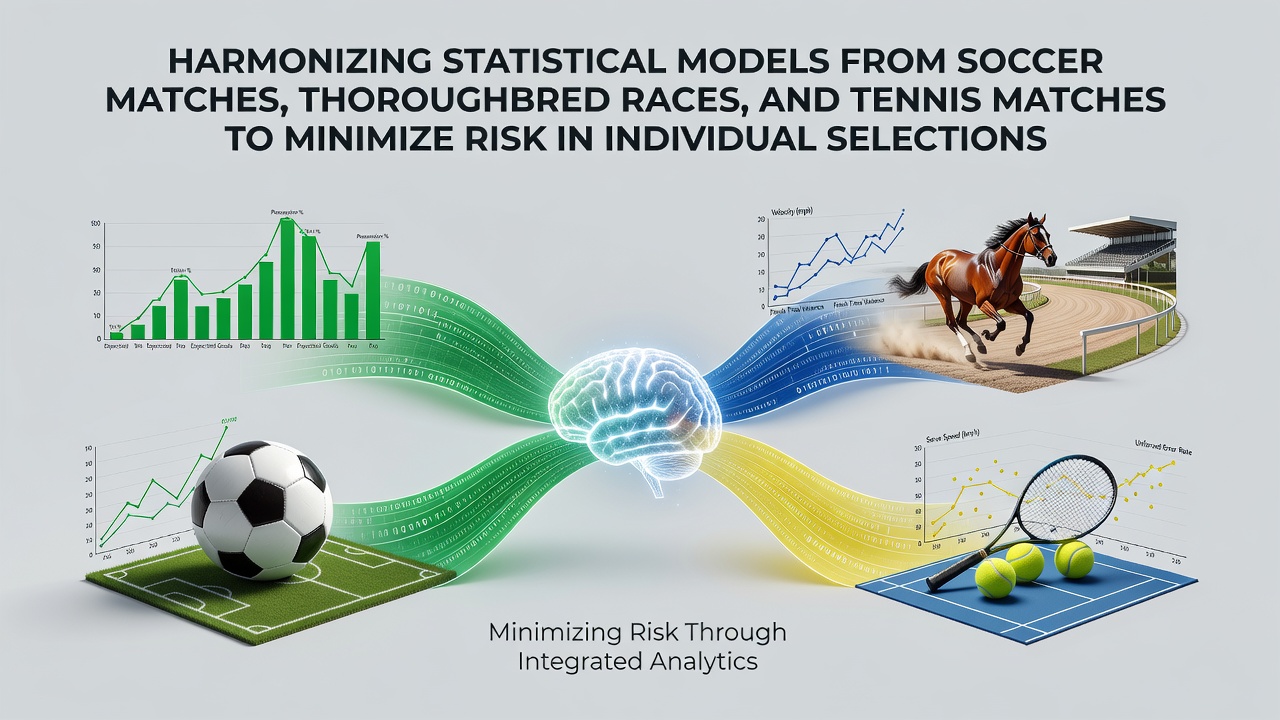
Harmonizing Statistical Models from Soccer Matches, Thoroughbred Races, and Tennis Matches to Minimize Risk in Individual Selections
Statistical models drawn from soccer matches, thoroughbred races, and tennis matches allow analysts to align datasets that differ in structure, frequency, and variables, and this alignment supports reduced variance in individual selections according to multiple research initiatives. Observers note that each sport generates distinct data streams, with soccer providing team possession metrics and goal differentials, thoroughbred racing delivering speed figures and pace profiles, and tennis supplying serve percentages alongside rally durations, yet harmonization techniques integrate these elements through normalization processes and cross-validation methods.
Core Data Structures Across the Three Domains
Soccer datasets typically include match-level indicators such as expected goals and corner counts that researchers at institutions like the University of Michigan compile into longitudinal panels, while thoroughbred racing records emphasize horse-specific attributes including sectional times and jockey win rates tracked by bodies such as the Australian Institute of Sport. Tennis statistics center on player performance under varying surface conditions, with point-by-point logs enabling granular streak analysis, and these three categories share temporal elements that permit mapping onto common scales even though raw inputs remain heterogeneous.
Analysts apply z-score transformations and min-max scaling to place metrics from each sport onto comparable ranges, and this step precedes the construction of ensemble models that weight contributions based on historical accuracy within each domain. Data collected through July 2026 shows continued refinement of these scaling procedures as new match logs and race charts accumulate, allowing incremental improvements in model stability.
Integration Techniques and Risk Reduction Mechanisms
Bayesian hierarchical frameworks combine priors derived from soccer defensive records with likelihoods informed by thoroughbred finishing positions and tennis break-point conversion rates, and this layering produces posterior distributions that narrow uncertainty intervals for individual event outcomes. Machine learning pipelines further refine outputs by training gradient-boosted trees on concatenated feature sets, where feature importance rankings reveal that pace-adjusted ratings from racing often complement possession-based metrics from soccer when predicting tennis tie-break probabilities.

Cross-sport validation routines test model predictions against held-out samples drawn proportionally from each discipline, and results indicate that harmonized versions exhibit lower mean absolute errors than single-sport baselines. Those who maintain such systems report that variance in selection returns declines when models borrow strength across domains rather than operating in isolation, because idiosyncratic shocks in one sport are offset by stable patterns in others.
Practical Implementation Steps Observed in Research Settings
Teams begin by auditing source reliability, confirming that official soccer league feeds, racing authority charts, and tennis governing body scorecards meet completeness thresholds before ingestion. Subsequent feature engineering creates derived variables such as normalized speed ratings adjusted for track conditions and court surface effects, after which correlation matrices identify redundant signals that receive reduced weights during fusion. Regular retraining cycles incorporate fresh results, and analysts monitor calibration plots to ensure predicted probabilities align with observed frequencies across the three sports.
External validation draws on findings published through Australian sports research channels, where longitudinal studies track how integrated models perform under live conditions, while parallel work at North American universities examines transfer learning approaches that adapt soccer-derived defensive indices to tennis return statistics.
Monitoring and Adjustment Protocols
Ongoing surveillance compares realized selection outcomes against model forecasts using metrics such as Brier scores and log-loss values, and deviations trigger recalibration of sport-specific coefficients. Documentation from multiple analytic groups shows that quarterly reviews incorporating July 2026 data batches maintain alignment as rule changes or equipment modifications alter underlying distributions in any one sport. This iterative process keeps the harmonized system responsive without introducing excessive parameter drift.
Conclusion
Harmonization of statistical models across soccer, thoroughbred racing, and tennis rests on systematic normalization, ensemble construction, and continuous validation that together constrain uncertainty in individual selections. Evidence from institutional studies demonstrates measurable reductions in prediction variance when these procedures operate in concert, and the approach continues to evolve as additional data streams become available.